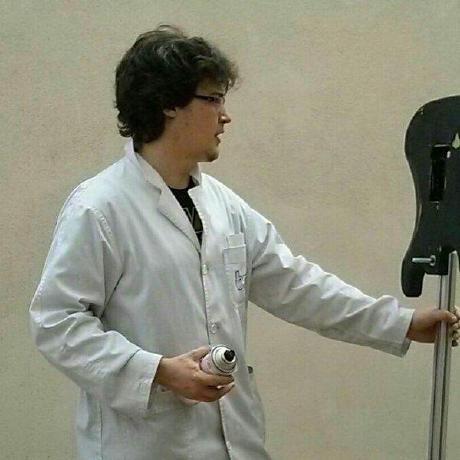
Raider
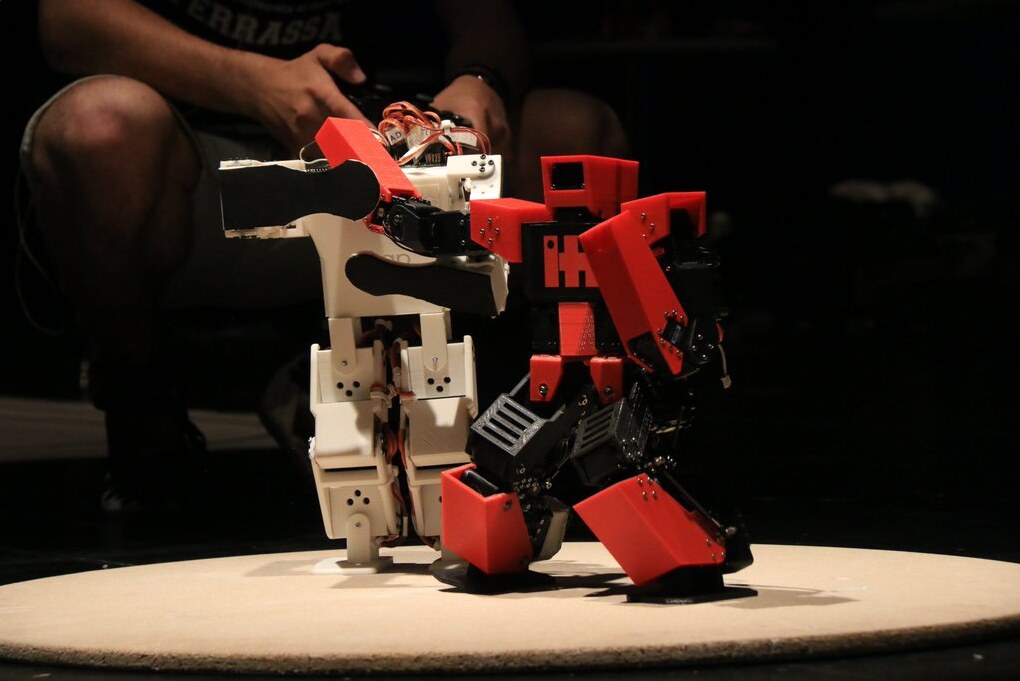
Raider is a competition humanoid with 24 degrees of freedom. Its name stands for Robot Antropomórfico para la Investigación y Desarrollo en Entornos Reales. It started as a prototype for my bachelor’s thesis at Universidad Carlos III de Madrid in 2014, which already won two of the CEABOT tests. The final version was unbeaten for several years in the humanoid competitions of the LNRC, and it was one of the test platforms of my master’s thesis on oscillator-based locomotion.
The robot
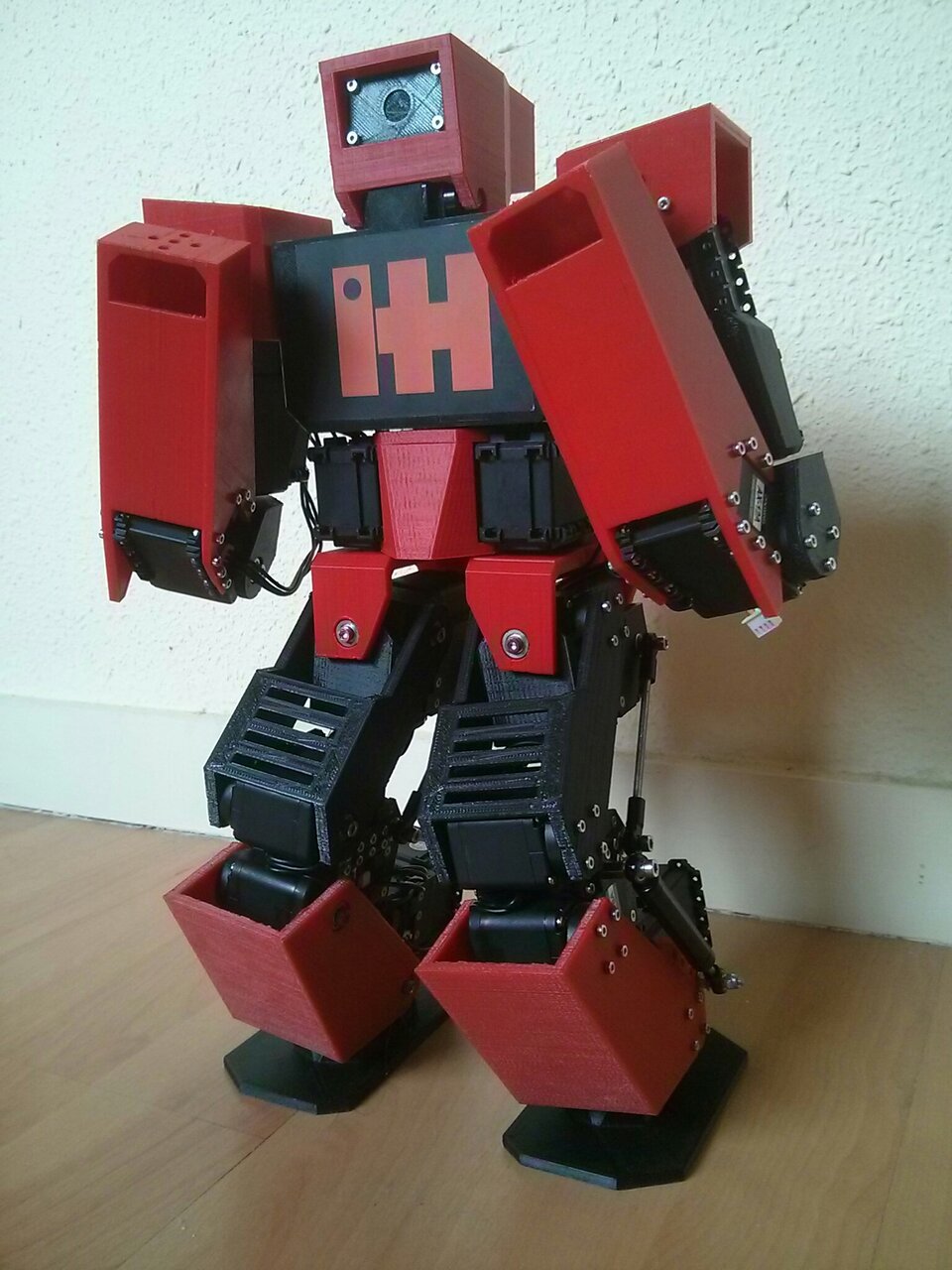
Of its 24 degrees of freedom, 23 are Dynamixel servos, 17 AX-12A and 6 AX-18A in the legs, and the other one moves the neck. The legs are based on a pantograph mechanism with RC4WD shock absorbers between the knee and the ankle that follow the extension movement. Every joint has a double shaft and bearings, and the whole robot is 100% printable. It’s controlled by a BeagleBone Black and an OpenCM9.04, has an IMU and runs on 3S LiPo batteries.
With so many joints working together, the synchronization of the actuators is critical, not only for the walk to work but also to keep the mechanical parts in one piece.
LNRC
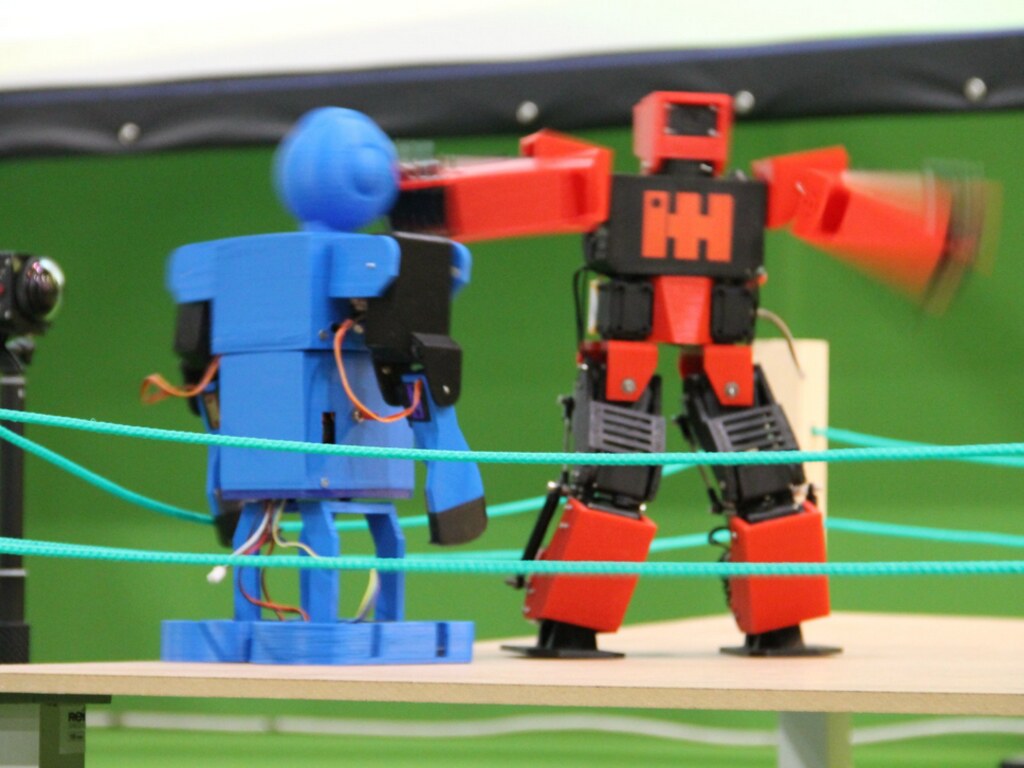
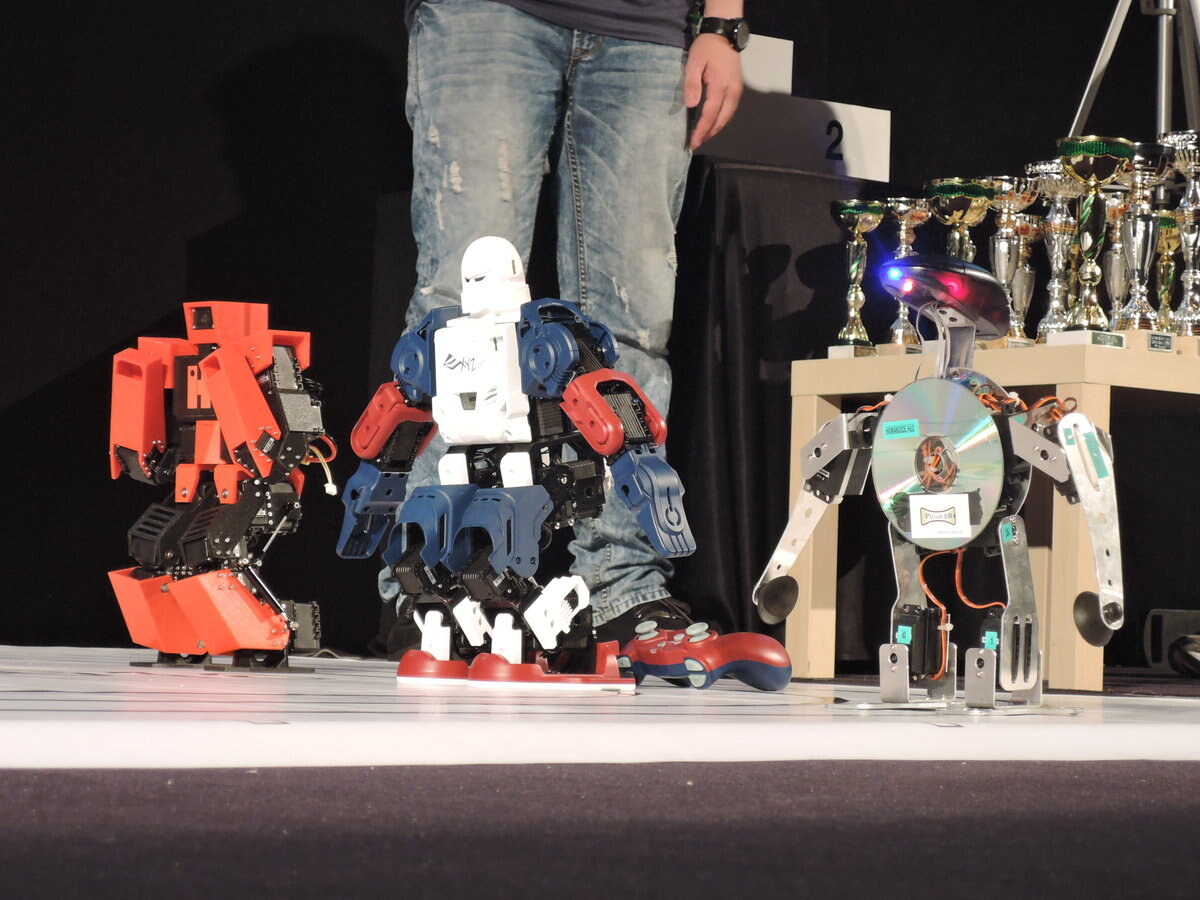
Raider competed in the humanoid competitions of the LNRC, the Spanish national league of competition robotics, where it was unbeaten for several years and became the humanoid with the most wins in the league. Some of its first places:
- Global Robot Expo
- Euskobot
- Cosmobot
- Japan Weekend
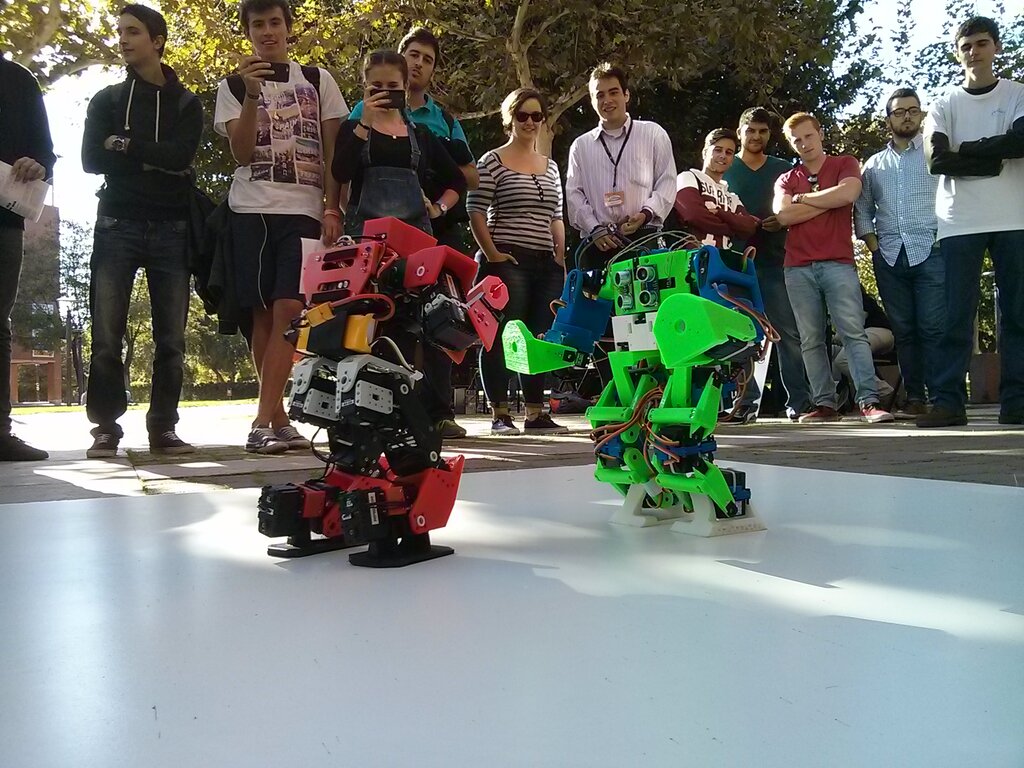
The photo at the top of the post is Raider fighting Grap, another competition humanoid. Some more from the fights:
 |
 |
In December 2017, El País covered the 10th edition of Cosmobot, with Raider as the lead of the story (in Spanish): Los guerreros de la robótica no solo existen en la ciencia ficción japonesa
At the Madrid Gaming Experience 2016, the LNRC fights were recorded in 360°. This is the first match of the event, Raider against Alpha:
And outside the competitions, here it is teaching a lesson to a coffee maker that was looking for trouble:
Walking with oscillators
In my master’s thesis, Raider was the robot used to test oscillator composition on a complex morphology, together with Zowi, Kame and Maus. Of its 24 degrees of freedom, 13 are used to walk: the arms stay still, with the elbows bent and the forearms pointing up, as in the standing photo above. The legs are controlled with inverse kinematics, so their oscillators move the position of each foot in millimetres, while the waist and the yaw joints of the legs are controlled directly, in degrees.
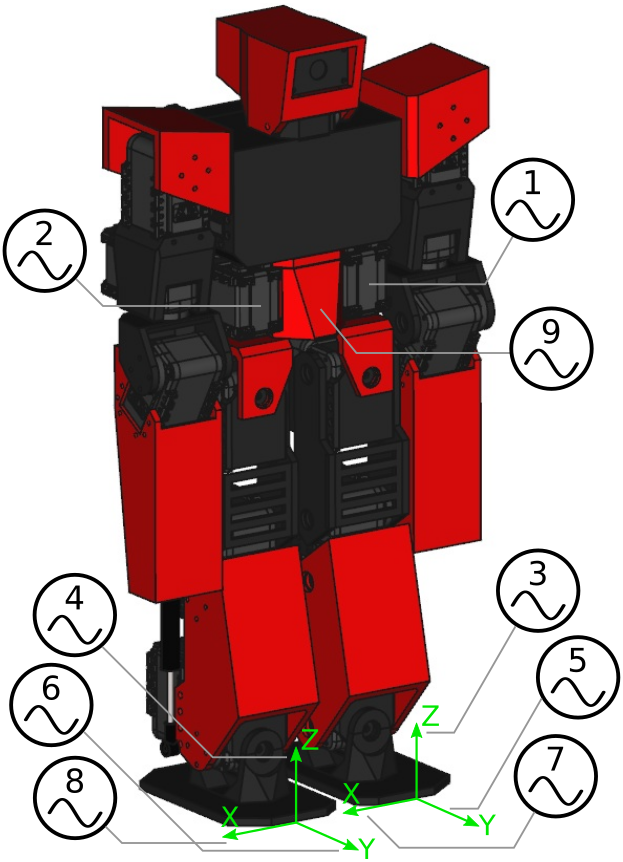
The pendulum formula would give a period of about 1100 ms, but a competition robot needs smaller and faster steps, so I halved it to 550 ms and used small amplitudes, which make the walk more robust. The Y and Z movements of each foot are 90° out of phase, so the foot follows an elliptical path. The lateral sway is in phase with the legs, so the weight moves to the leg that is fully extended, and the waist counteracts the effect of the yaw oscillators (its phase, 270°, was found empirically).
| Oscillator | Waveform | Offset | Amplitude | Period | Phase |
|---|---|---|---|---|---|
| 1 | Sine | 90° | 4° | 550 ms | 90° |
| 2 | Sine | 90° | 4° | 550 ms | 90° |
| 3 | Sine | −135 mm | 8 mm | 550 ms | 0° |
| 4 | Sine | 135 mm | 8 mm | 550 ms | 180° |
| 5 | Sine | −26 mm | 13 mm | 550 ms | 270° |
| 6 | Sine | −26 mm | 13 mm | 550 ms | 90° |
| 7 | Sine | 8 mm | 10 mm | 550 ms | 30° |
| 8 | Sine | −8 mm | 10 mm | 550 ms | 30° |
| 9 | Sine | 90° | 6° | 550 ms | 270° |
To measure it, Raider walked the same track six times, starting 5 cm before the start line so the gait was already stable when crossing it. On average it took 3.53 steps per second, with a speed of 92 mm/s (1.18 body lengths per second, with a body length of 72 mm) and 26 mm per step.
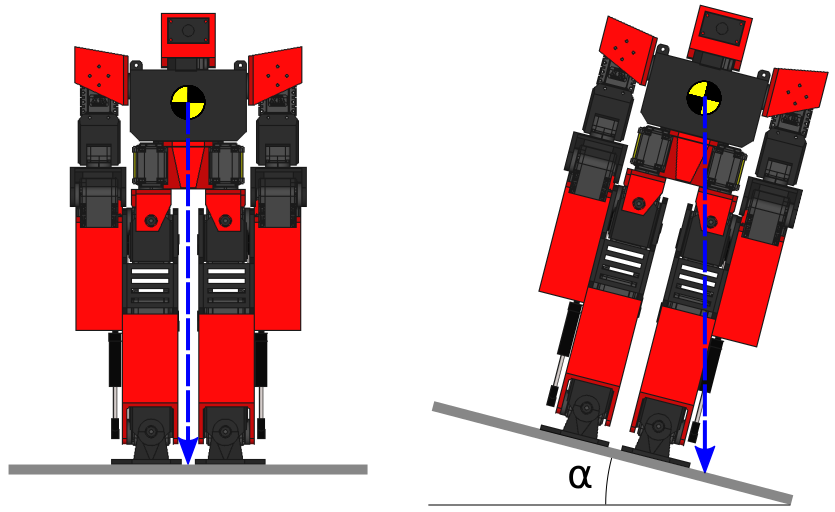
In this test the robot had no sensory feedback, so sometimes it slipped and its orientation changed a little. Raider has an IMU, and the thesis also proposes using sensors like it to modulate the oscillators, for example changing the offset of the legs with an inclinometer to keep the centre of gravity over the feet on a slope.
The prototype
Raider was born in the mini humanoid group of AsRob, the robotics association of the university, a group very involved in 3D printing: printing techniques, structure design and materials. I started building its first prototype in my third year at university, and it became my bachelor’s thesis.
I needed a robot programmable in C/C++ without being tied to a specific IDE, with a camera to run OpenCV, room for new sensors and actuators, and servos strong enough (at least 12 kg·cm) to carry all that weight. Most of its parts were designed in OpenSCAD, parametric so they were easy to change and reprint:
- Head: the camera went inside, tilted by a MG90s micro servo with metal gears to survive the falls.
- Waist: a Dynamixel AX-12A that turned the torso. Together with the head, it worked as a distributed pan-tilt: the camera could look anywhere while the legs stayed still.
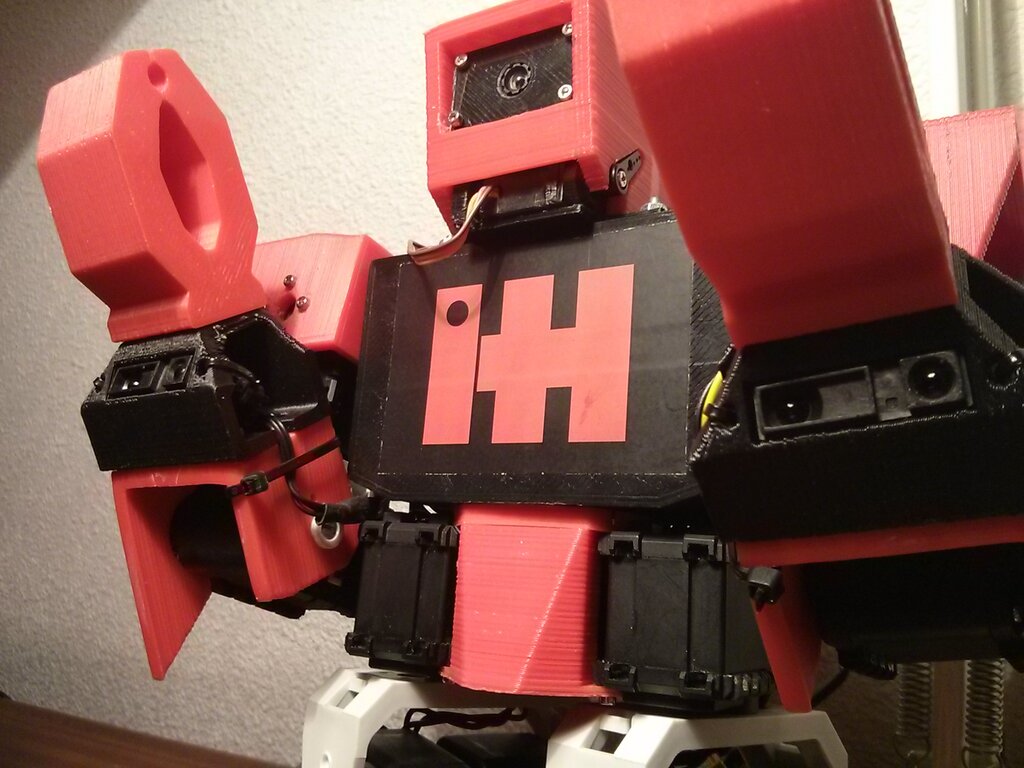
- Arms: modular, with a Sharp infrared distance sensor in each forearm.
- Legs: short and stiff, to take load off the joints and lower the centre of gravity.
- Feet and ankles: as large as the CEABOT rules allow, with the ankle designed to put the weight in the centre of the sole.
In total, 19 Dynamixel AX-12A servos plus the micro servo for the head.
Electronics
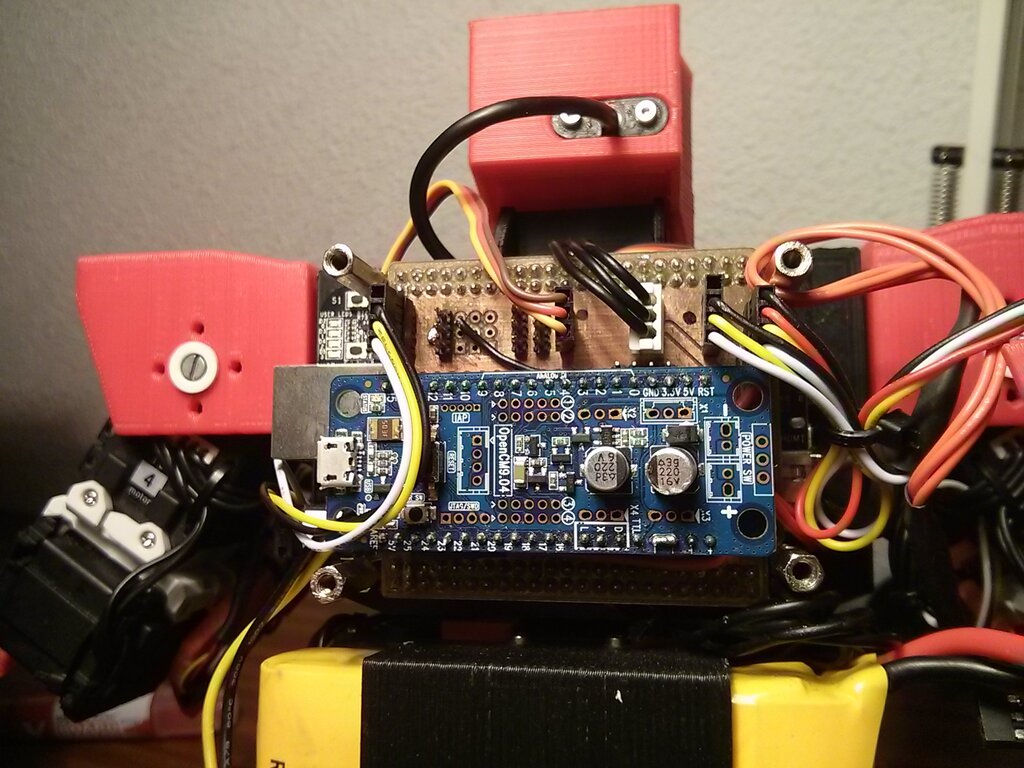
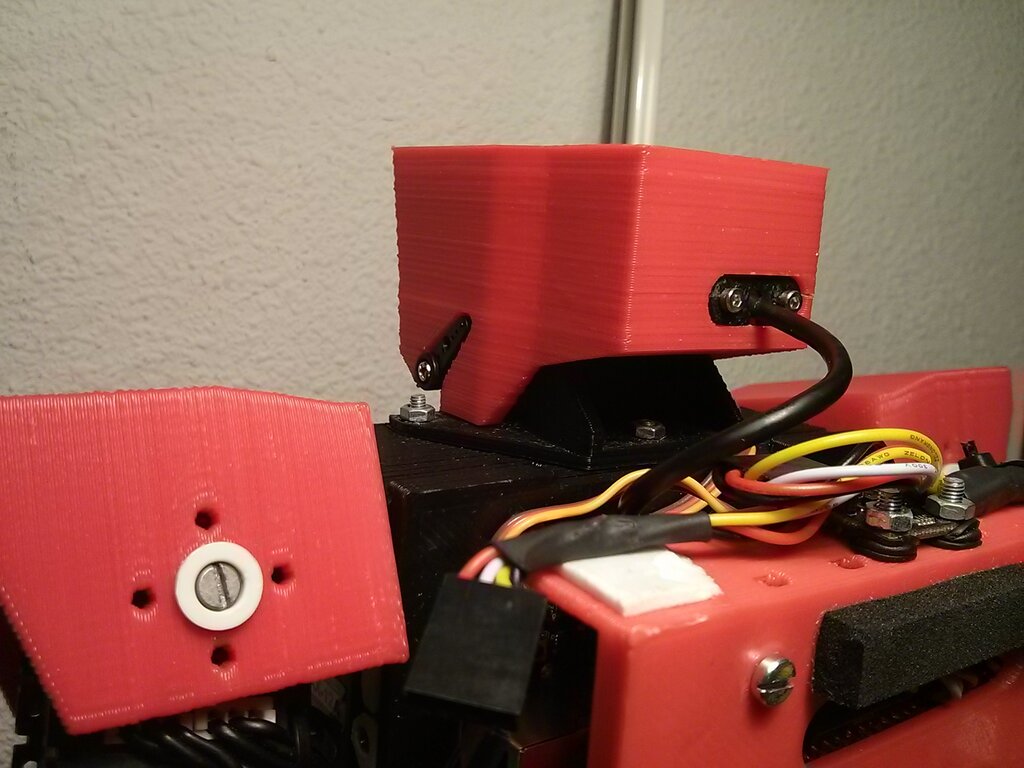
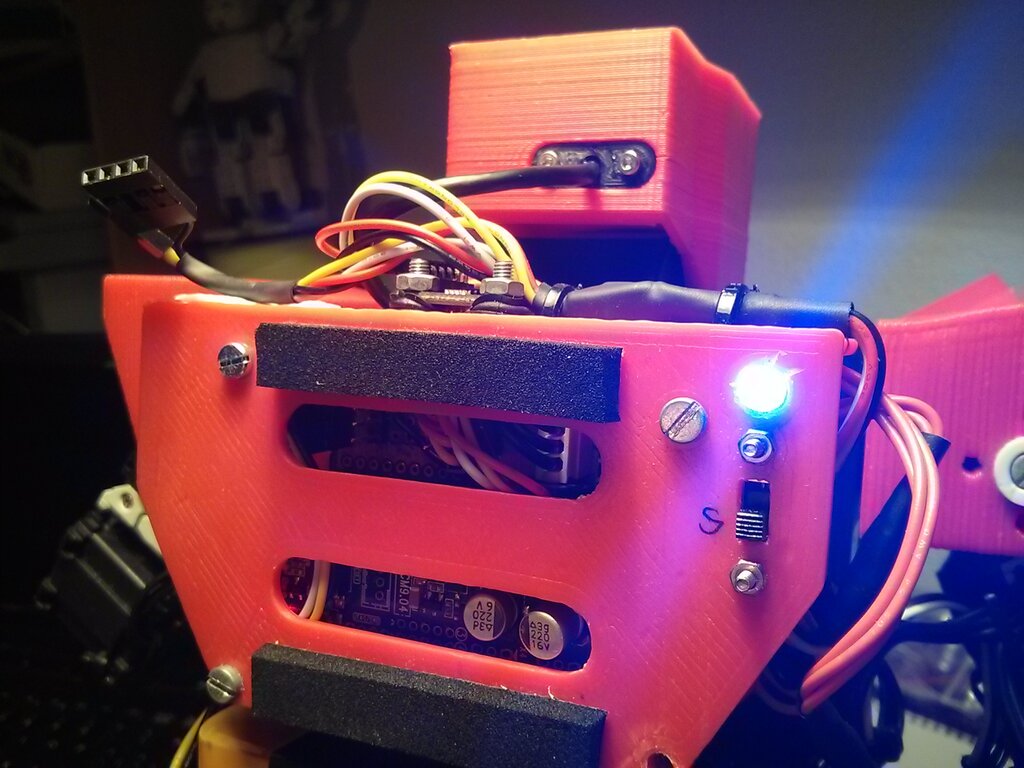
The prototype had two brains. A BeagleBone Black did the thinking: the camera (a Microsoft LifeCam), an MPU9150 IMU, a compass and the two infrared sensors, with OpenCV and ZBar for vision. It sent orders over a serial port to an OpenCM9.04, which drove the servos and stored all the moves: walking, turning, side steps, kicks, punches, getting up after a fall… A custom expansion board, designed in KiCad, connected everything, and an emergency switch on its back cut the communication between both boards and left the robot still in a neutral position.
 |
 |
 |
 |
For the battery I chose a 3S 1750 mAh LiPo: at 109 g, it weighed half as much as a 9.6 V NiMH pack of 215 g, and it fit on the waist instead of the back, which kept the centre of gravity low. With an estimated average consumption of 136 W, that gave between 8 and 9 minutes of autonomy: enough, since CEABOT tests last 5 minutes at most.
Spain Experience
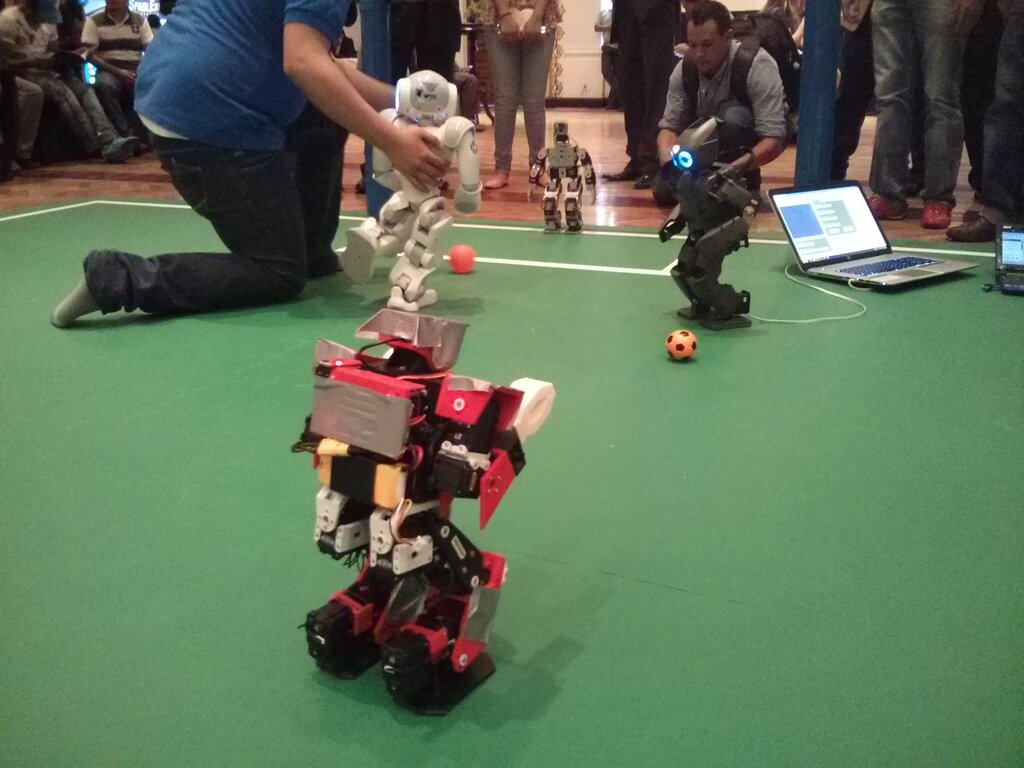
The first real test was in Mexico. Cinvestav invited members of the UC3M Robotics Lab and AsRob to a robot football match inspired by RoboCup, during Spain Experience, an event organized by the Spanish football league. The field was made for bigger robots.
 |
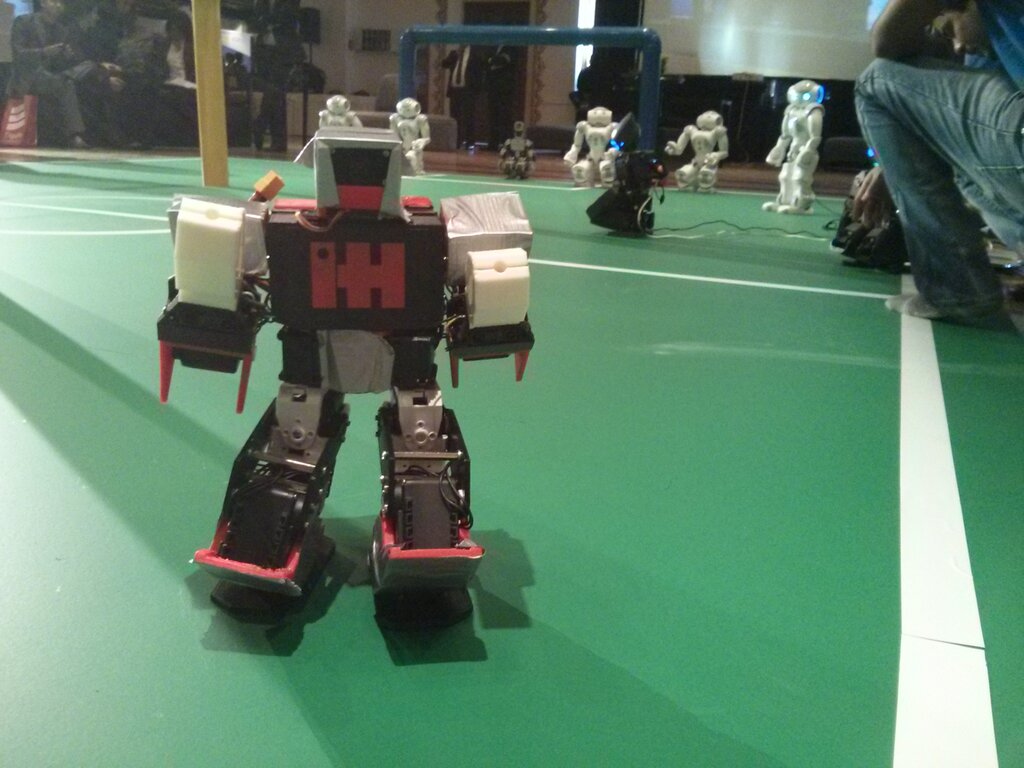 |
The prototype was teleoperated over Bluetooth from a smartphone for more than two hours, changing the battery about every 10 minutes. It kicked the ball, ran next to robots bigger than mini humanoids and got up after a few falls. The printed parts survived all the hits, and the electronics never overheated or stopped.
CEABOT 2014
CEABOT gathers mini humanoids (under 50 cm) from Spanish universities and independent teams. In 2014 there were four tests: obstacle race, stairs, sumo and, for the first time, vision. The prototype entered three of them:
- Vision: the robot stands in the centre of the field, surrounded by obstacles with QR codes. Each code tells it how much to turn to find the next one, and the prototype used the compass to control the turn. It was the only robot able to tell more than one marker apart: it read and followed four. First place.
- Navigation: cross the field between obstacles and come back. It finished the whole test in 2 minutes and 13 seconds, and it was the only robot that managed to come back from the finish zone. First place.
- Sumo: with its two infrared sensors, it threw a punch with one arm or the other when the opponent was close, walked towards it when it was far, and turned its waist to look around when it saw nothing. After every move it checked if it had fallen, and got up if so. Of the seven robots, it reached the final, and lost the last bout. Second place.
That gave it second place overall, even without entering the stairs test.
Here is the prototype navigating autonomously with computer vision:
The thesis ended with a list of future improvements, including more degrees of freedom: the starting point of the final Raider.
As always, everything is open source:
- Raider repository: 3D parts, FreeCAD model, expansion board and code
- Bachelor’s thesis (in Spanish): “Desarrollo de una plataforma robótica mini-humanoide con visión artificial”, UC3M, 2014, with part drawings and board schematics
- Master’s thesis (in Spanish): “Locomoción basada en osciladores para robots con patas”, UC3M, 2016
Comments